Validation
This page is the citable summary of ctrl-freak's validation benchmark suite. The
suite exists for scientific trust, not marketing: when a manuscript states that
parameters were calibrated with ctrl-freak's ga() / nsga2(), a reviewer should
have no grounds to doubt the optimizer. The claim it substantiates is parity —
across standard problems with known optima, ctrl-freak's results are statistically
indistinguishable from pymoo and
DEAP. The full, auto-rendered report (every table
and figure, regenerated from the committed results JSON) lives in the repository:
benchmarks/README.md.
Methodology
- Problems. Six single-objective functions with known global optima (Sphere, Rosenbrock, Rastrigin, Ackley, Griewank, Schwefel, all 10-D) and six multi-objective problems with analytical Pareto fronts (ZDT1, ZDT2, ZDT3, ZDT4, ZDT6 at 30 variables; DTLZ2 at 3 objectives / 12 variables).
- Identical algorithm across libraries. All three libraries run the same genetic algorithm: ctrl-freak's exact single-child, every-eligible-variable SBX crossover (eta 15) is ported into custom pymoo and DEAP operators, polynomial mutation (eta 20, one expected gene flip per genome) is applied to every offspring, and tournament selection / elitist (SO) and NSGA-II (MO) survival are aligned. The evaluation budget is identical to the evaluation call (SO: 20 100 evaluations; MO: 25 100). The comparison therefore isolates the algorithm, not the configuration.
- Statistic. Parity is an equivalence claim, so it is adjudicated by overlapping variance: ctrl-freak and a baseline are equivalent for a given problem and metric when the gap between their means is smaller than the larger per-seed standard deviation (a non-significant difference test would not be sufficient). Each cell reports the verdict and its margin. Thirty seeds.
| Field | Value |
|---|---|
| Seeds | 30 (0–29) |
| ctrl-freak | 0.2.0 |
| pymoo | 0.6.1.6 |
| deap | 1.4.3 |
| numpy | 2.4.1 |
| SO budget | pop 100 × 200 gen (20100 evals) |
| MO budget | pop 100 × 250 gen (25100 evals) |
| SBX / PM eta | 15.0 / 20.0 |
Result
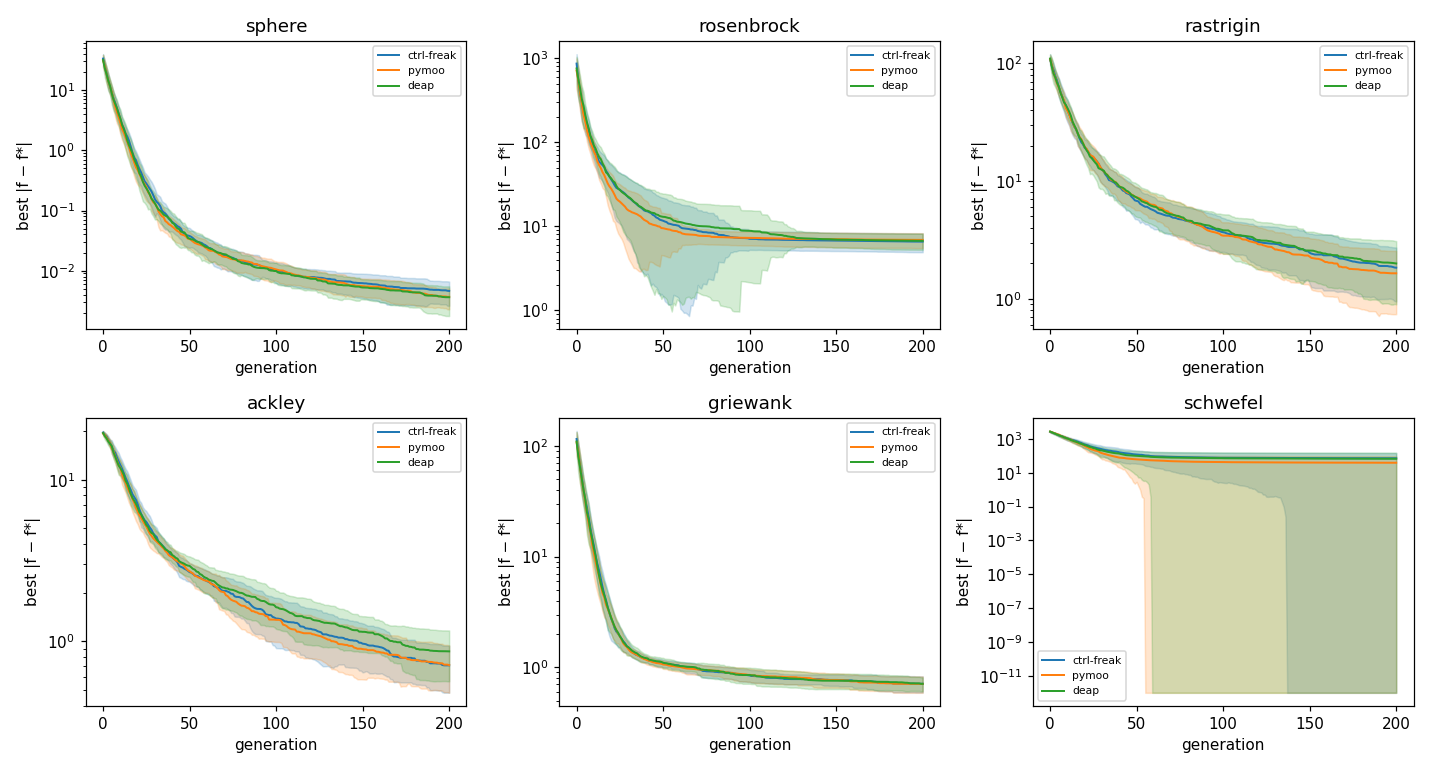
Single-objective parity is led by the continuous error metrics |f − f| and ‖x − x‖: ctrl-freak is statistically indistinguishable from both baselines on all six problems, including the multimodal Rastrigin, Ackley, and Schwefel.
| Problem | ctrl-freak | pymoo | deap | vs pymoo | vs deap |
|---|---|---|---|---|---|
| sphere | 4.61e-03 ± 1.99e-03 | 3.68e-03 ± 1.39e-03 | 3.63e-03 ± 1.86e-03 | equivalent (margin +1.1e-03) | equivalent (margin +1.0e-03) |
| rosenbrock | 6.58e+00 ± 1.65e+00 | 6.90e+00 ± 1.39e+00 | 6.72e+00 ± 1.46e+00 | equivalent (margin +1.3e+00) | equivalent (margin +1.5e+00) |
| rastrigin | 1.84e+00 ± 8.87e-01 | 1.65e+00 ± 9.06e-01 | 1.99e+00 ± 1.10e+00 | equivalent (margin +7.1e-01) | equivalent (margin +9.4e-01) |
| ackley | 7.10e-01 ± 2.29e-01 | 7.12e-01 ± 2.32e-01 | 8.67e-01 ± 3.01e-01 | equivalent (margin +2.3e-01) | equivalent (margin +1.4e-01) |
| griewank | 7.11e-01 ± 1.18e-01 | 7.09e-01 ± 1.19e-01 | 7.10e-01 ± 1.02e-01 | equivalent (margin +1.2e-01) | equivalent (margin +1.2e-01) |
| schwefel | 7.04e+01 ± 7.27e+01 | 3.84e+01 ± 5.47e+01 | 6.62e+01 ± 8.51e+01 | equivalent (margin +4.1e+01) | equivalent (margin +8.1e+01) |
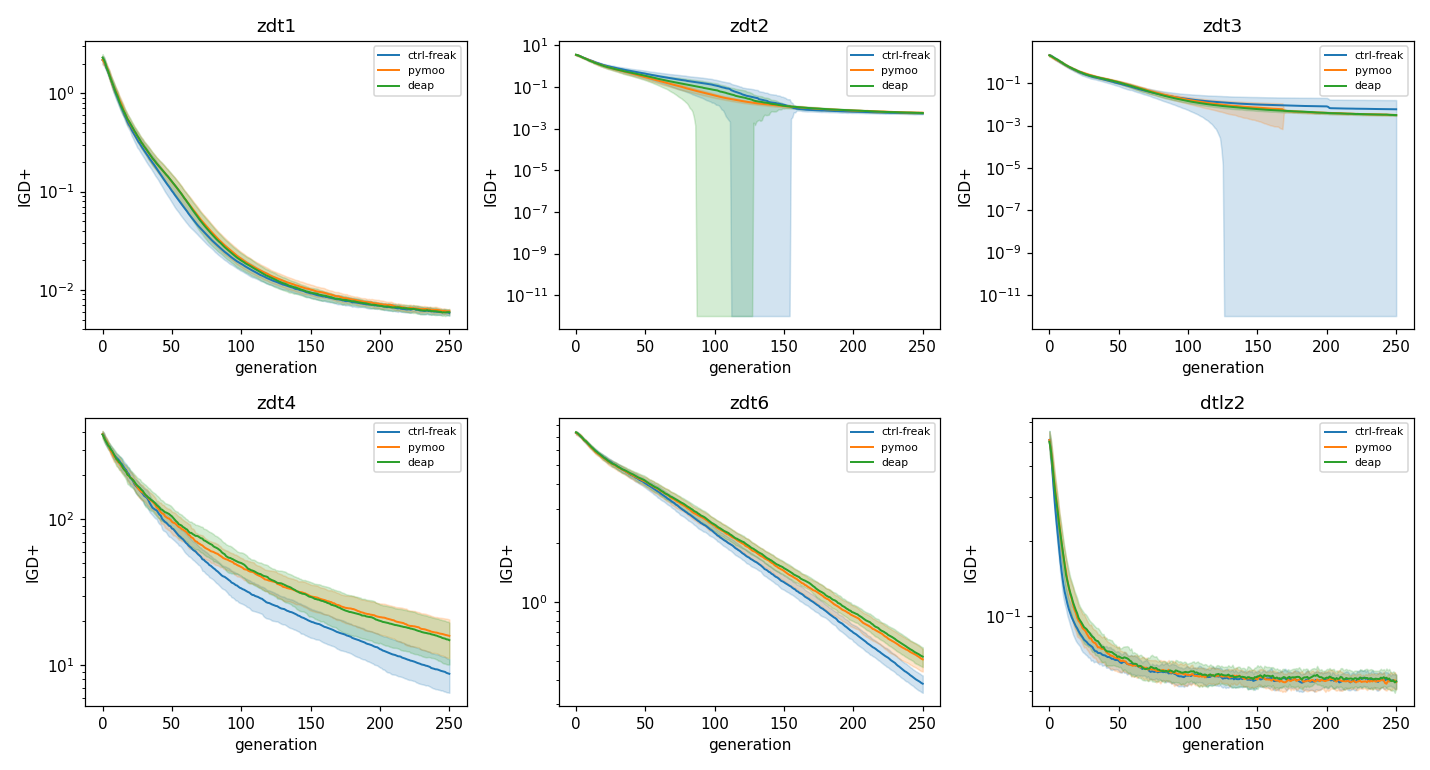
Multi-objective convergence (IGD+ to the analytical front) is statistically indistinguishable from both baselines on ZDT1, ZDT2, ZDT3, and DTLZ2, on all three metrics (IGD+, GD, hypervolume).
| Problem | ctrl-freak | pymoo | deap | vs pymoo | vs deap |
|---|---|---|---|---|---|
| zdt1 | 5.85e-03 ± 3.75e-04 | 6.07e-03 ± 3.63e-04 | 5.94e-03 ± 4.22e-04 | equivalent (margin +1.5e-04) | equivalent (margin +3.3e-04) |
| zdt2 | 5.46e-03 ± 4.38e-04 | 5.87e-03 ± 3.77e-04 | 5.69e-03 ± 4.77e-04 | equivalent (margin +2.7e-05) | equivalent (margin +2.4e-04) |
| zdt3 | 5.91e-03 ± 1.02e-02 | 3.17e-03 ± 2.63e-04 | 3.14e-03 ± 2.22e-04 | equivalent (margin +7.4e-03) | equivalent (margin +7.4e-03) |
| zdt4 | 8.73e+00 ± 2.26e+00 | 1.59e+01 ± 4.68e+00 | 1.48e+01 ± 4.73e+00 | not equivalent — ctrl-freak better | not equivalent — ctrl-freak better |
| zdt6 | 3.81e-01 ± 3.88e-02 | 5.08e-01 ± 6.77e-02 | 5.25e-01 ± 6.04e-02 | not equivalent — ctrl-freak better | not equivalent — ctrl-freak better |
| dtlz2 | 5.47e-02 ± 3.67e-03 | 5.43e-02 ± 3.61e-03 | 5.47e-02 ± 3.28e-03 | equivalent (margin +3.3e-03) | equivalent (margin +3.6e-03) |
Two documented exceptions
The "statistically indistinguishable" sentence has two honest exceptions, both recorded because the suite reports faithfully rather than selectively:
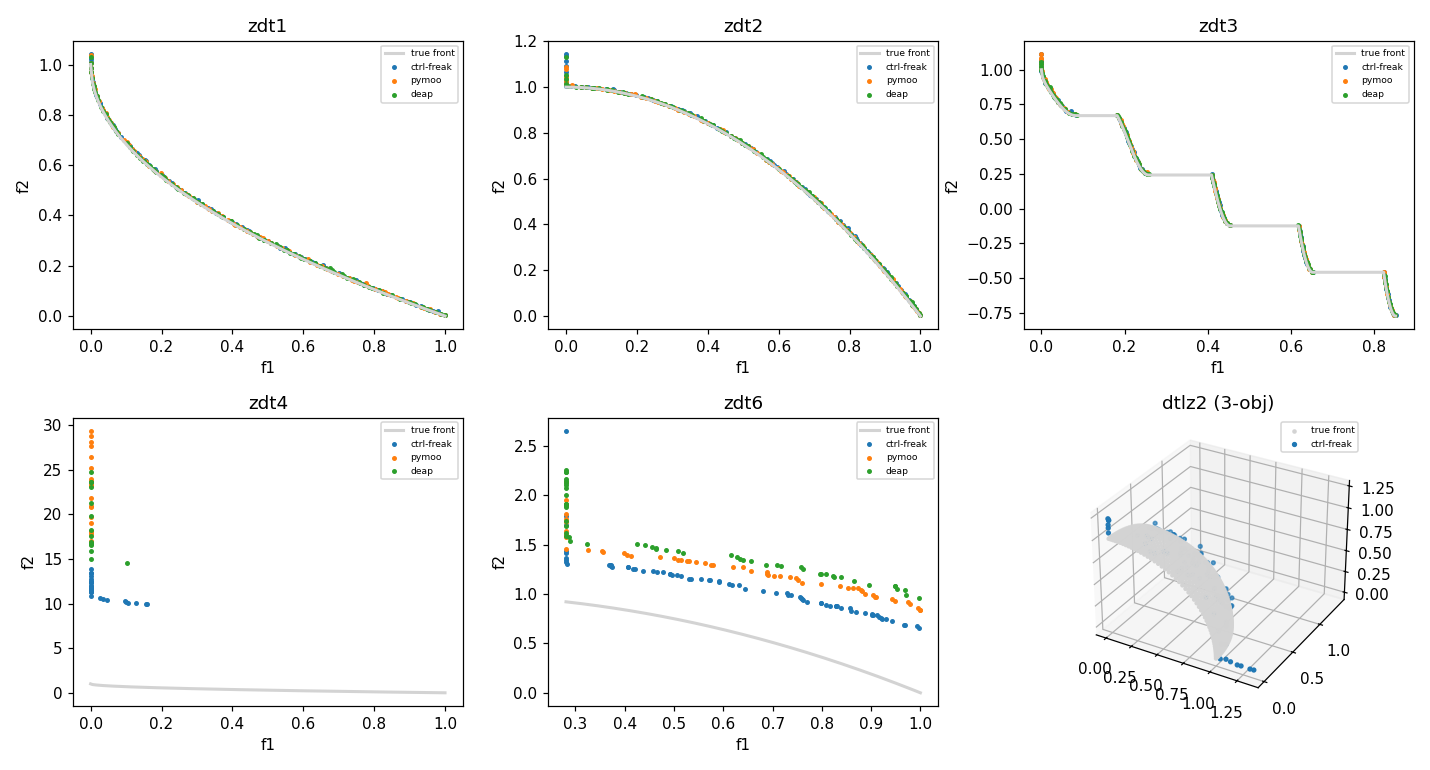
- ZDT4 and ZDT6. None of the three libraries converges on these hardest
multimodal / biased problems at this budget; the symmetric variance test flags
the gap, but in ctrl-freak's favour — ctrl-freak's IGD+, GD, and hypervolume
are at least as good as both pymoo and DEAP. The parity / trust claim is not
threatened (ctrl-freak is at-least-as-good); the clean equivalence sentence
simply does not apply where no library converges. (ZDT4's hypervolume is
0for all three because every final front lies outside the[1.1, 1.1]reference box.) - Single-objective success rate is
0for every problem and every library. The committed ε thresholds are strict (e.g. Sphere ε = 1e-6 while all three reach ~4e-3 at this budget), so the binary success metric is uniformly zero. This is a documented strict-threshold non-convergence property at this budget, not a failure: the three libraries reach the same error band, and the parity evidence rests on the continuous error metrics above.
Figures
Seed-mean convergence with a ±std band, three libraries:
Final non-dominated fronts against the analytical true fronts (ZDT4/ZDT6 sit off the front for all three libraries — the documented exceptions; the DTLZ2 panel shows ctrl-freak against the unit-sphere octant, with per-library parity quantified in the report's IGD+/GD/HV table):